Beginning between the trees
Welcome to this blog which is written with the intention of connecting some of the branches of my professional life experience as an educator. I am a relatively new blog writer and this starting point is inspired by some of the thoughts and experiences I have encountered, connecting me to nature and all it can offer learners, educators and leaders.
I have always enjoyed being in nature and appreciated the natural world of plants, trees and creatures living among them. It has only been in more recent years that I have begun to notice the profound impact that being outdoors has on my ability to reflect, evaluate and innovate.
Two professional learning experiences have enabled me to notice this metaphorical sunshine of inspiration shining between the trees. They are my training in the principles of the Froebel approach and a module in Outdoor Learning which I undertook as part of a Masters course in Special and Inclusive Education, both of will underpin much of the content to follow.
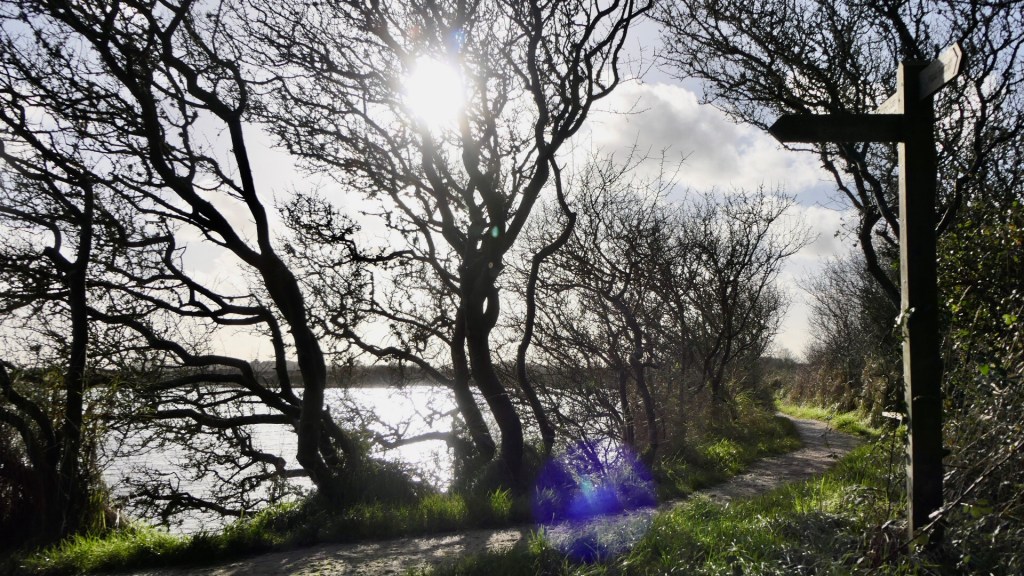
The photograph above represents my professional path. On this path, which is far from straight or smooth, my growth has flourished through training as an Early Years Educator twenty-five years ago to graduating with QTS as a primary teacher, progressing as an Early Years Leader, Deputy Head of Juniors and Head of Pre-Prep. After eighteen years of full time, school timetabled roles, I now love working on a more freelance or perhaps, I might describe it as ‘free range’ basis as a consultant and mentor, enjoying some teaching in a maintained nursery school and volunteering as a school governor.
The signpost in the photograph is significant as a reminder of some of the decisions I have made in life, including when to start my career as a teacher, when to pursue career development through promotion to leadership roles, when to move schools and when to change direction to explore other pathways of education. Sometimes in life there are explicit, obvious directions to follow and sometimes we need to find our own way, relying on our inner navigation systems to explore new pathways towards a less defined destination. I chose to step off the certain, smooth tarmac path to wander along a pathway of curiosity which is muddy and pebbly in places with fertile soil for growth. The decision I made was to only undertake work which fulfilled the dual criteria of firstly being of personal interest to me and secondly being work that I felt would make a difference to the educational experiences of future generations. Now two years into this life of self directed workload and freedom from the school timetable and calendar, I have found more time and space to open my eyes wider, look up and out and begin to discover what else I could learn from and share with, the wonderful world of education.
The blue lens flare caused by the sunlight caught in my camera could be representative of a globe, a shiny marble, a big blue eye, a fairy in a bubble, a spiritual orb or the simple sphere that was central to the theory of Friedrich Froebel who created the gifts of spheres as early playthings for young children. The discovery of the properties of spheres brings playful exploration through many games and activities, underpinning many mathematical concepts. In nature, spheres can be found in berries, flower heads and pebbles and looking up, a whole solar system of spheres surrounds our spherical planet.
Another principle from Froebel is ‘Engaging with Nature’ (Froebel Trust), which he advocates as an essential element of education, not merely taking children outside, but enabling experiences that allow them to engage with nature as part of nature, respecting the relationships, the interplay and the impact between the human, animal and plant species that coexist as part of the universe. I am developing my knowledge of how Initial Teacher Education (ITE) can encourage educators to incorporate opportunities for children to engage with nature.
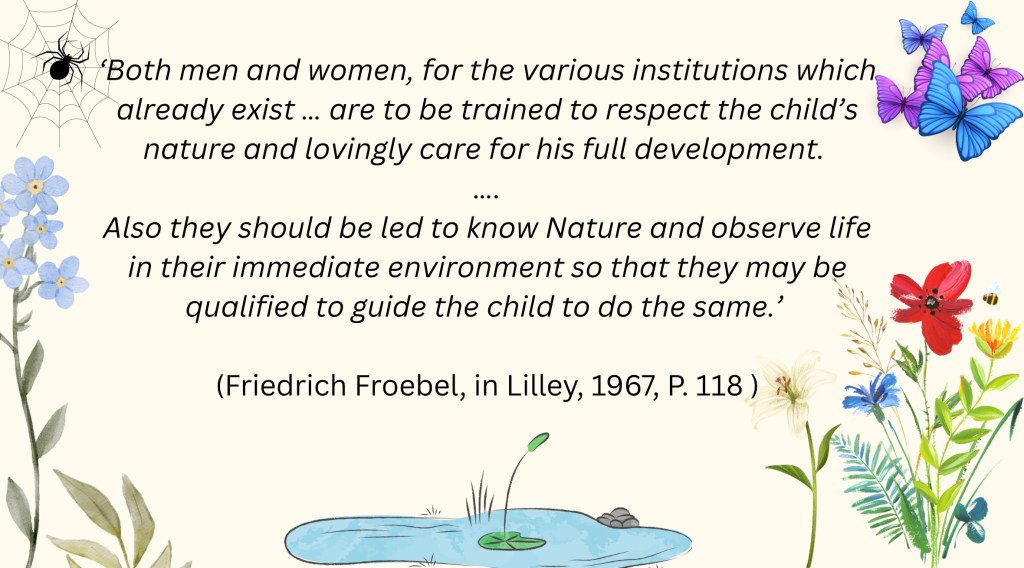
Froebel was specific in his direction that teachers must engage in nature themselves if they are to convey a similar level of connection for the children in their care.. For those who teach children in Early Years, the Statutory Requirements of the EYFS (DfE, 25/26) include giving children access to outdoors. It would seem to follow that any training of educators who may teach children in Reception or Nurseries, should include the pedagogical basis of how and why children should learn through play outdoors. I am interested to learn about the experiences and ideas of educators relating to outdoor learning and how the UK provision compares to international counterparts.
How did you begin taking children outdoors to learn?
Was outdoor learning part of your training, did you learn from others, or did you lead the way?
If you have any thoughts you would like to share then please post either on this blog or via the LinkedIn post where you saw it.
Thank you for your interest and engagement.
Amanda
References
DfE (2025) Early Years Statutory Framework Available at: https://www.gov.uk/government/publications/early-years-foundation-stage-framework–2
Froebel Trust Available at: https://www.froebel.org.uk/
Lilley, I.M (1967) Friedrich Froebel: A selection from his writings. Cambridge: Cambridge University Press.

